In short
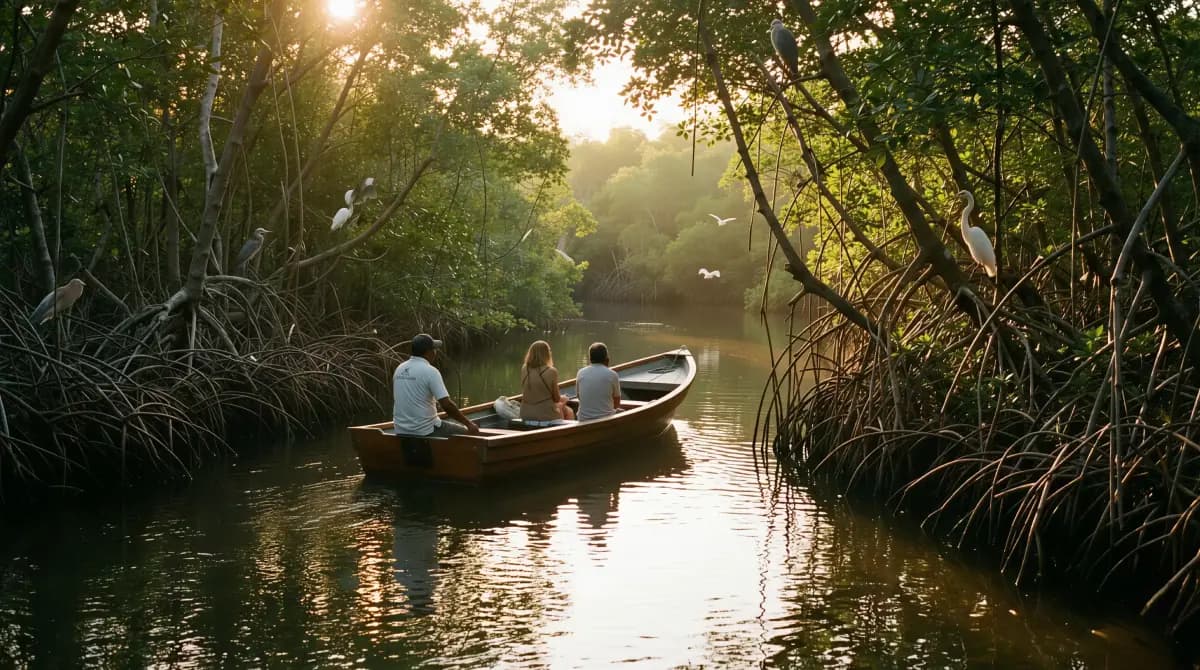
The Chacahua Lagoons are a mangrove National Park on the Oaxaca Coast, ~61-65 km (about 1 h 20 min) from Puerto Escondido along Federal Highway 200. In 2026, with KORU you rent your car or jeep and reach the Zapotalito dock at your own pace; from there a boat crosses the mangrove channels in 30-45 min.
What are the Chacahua Lagoons and why are they worth it?
Lagunas de Chacahua National Park was decreed on 9 July 1937 under Lázaro Cárdenas and is considered Mexico's first protected area with tropical ecosystems. According to CONANP (DOF 2013) it covers 14,896.07 ha, of which about 2,710 ha (19.13%) are mangrove, holding Mexico's four species: red, black, white and buttonwood. It has been Ramsar Site of international importance No. 1819 since 2008 and a sea-turtle sanctuary since 1986. It sits in the municipality of Villa de Tututepec de Melchor Ocampo, and the Chacahua-Pastoría lagoon system is joined by the Corral Channel.
How do you get to Chacahua from Puerto Escondido?
Chacahua is about 61-65 km from Puerto Escondido, roughly 1 h 20 min to 1 h 30 min of driving along the well-maintained Federal Highway 200 (Puerto-Escondido.mx, 2026). Every route passes through Zapotalito, the main dock. A sedan works fine on the paved highway; only the final ~20 km toward Zapotalito are dirt road, where an SUV or jeep is more comfortable, especially in the rainy season. It is a comfort recommendation, not an absolute requirement.
In your own vehicle: take Highway 200 toward Río Grande, then the turnoff to Zapotalito. With a KORU car or jeep you arrive at your own pace and can leave it parked near the dock while you cross by boat.
By shared transport: vans run from Puerto Escondido to Río Grande and on to Zapotalito. Cheaper, but with rigid schedules.
By organized tour: agencies offer full-day trips from Puerto Escondido, around $2,000 MXN per person (about 9 hours, transport and boat; meals not included), sometimes including the crocodile farm. Convenient if you'd rather skip the logistics.
By boat from Zapotalito: the mangrove crossing takes only 30-45 min (about 40 min), not one or two hours.
What does the mangrove boat ride include?
At Zapotalito you hire a boat with local boatmen. The Zapotalito-to-Chacahua route runs around $250 MXN per person and takes only 30-45 min through the mangrove channels (Iván de Viaje reference, 2024-2025); there are cheaper short crossings, around $20 MXN. Ask the price before boarding and bargain respectfully, since the boatmen live off this work. Bring cash: the area has no ATMs and few places take cards.
When can you see the bioluminescence?
Bioluminescence is produced by dinoflagellates (Pyrodinium bahamense and Noctiluca scintillans) that flash blue-green when the water is stirred (México Desconocido). The deciding factor is a dark, new-moon night with little artificial light. Sources disagree on the best months: some point to November-February, others to the rainy season; in Chacahua it is visible much of the year, but with no guarantee any given night. It is Oaxaca's second best-known lagoon for it, after Manialtepec.
Get ready to disconnect
Chacahua is rustic: no ATMs, limited electricity and patchy signal. Bring enough cash, insect repellent, biodegradable sunscreen, a flashlight, water and a waterproof bag for your phone. Cabins run about $1,000-1,200 MXN per night and camping around $100 MXN per person (2024-2025 reference); to see the bioluminescence, plan to stay at least one night.
“Chacahua is best enjoyed at your own pace: rent your car or jeep with KORU in Puerto Escondido and get a quote on WhatsApp before you set off.”
— KORU RENT
Rent your car or jeep in Puerto Escondido
KORU fleet ready for the Oaxaca Coast
Puerto Escondido
Your base to explore the Oaxaca Coast
Frequently asked questions
Frequently asked questions
At KORU we operate in Puerto Escondido, your natural base for reaching Chacahua. Rent your car or jeep, drive Highway 200 at your own pace and leave it in Zapotalito while you cross by boat. Get a quote for your booking on WhatsApp and plan your mangrove getaway.